About WP8
MISSION
To provide a sound platform for international networking and activities in the area of physicochemical methods for corrosion testing, with a strong focus on metrological reliability, method development, data management and capacity building.
WP8 promotes the integration of correlative and intersectoral approaches to bring together laboratory, industrial and field testing, and supports the adoption of FAIR data management principles (Findable, Accessible, Interoperable, Reusable) to ensure transparency and reusability of corrosion data.
AIMS
- To maintain WP8 as a well-recognized international platform for scientific collaboration on the development, validation and correlation of innovative physicochemical and electrochemical corrosion testing techniques.
- To promote developments improving the metrological soundness and cross-sector correlation of physico-chemical corrosion testing, ensuring consistency, interoperability and FAIR use of experimental data.
- To encourage the use of advanced and complementary measurement techniques — such as optical and spectroscopic microscopy, neutrons and positrons, local electrochemical methods, and in-situ/operando analysis — to improve mechanistic understanding of corrosion phenomena.
- Foster interdisciplinary collaboration combining experimental corrosion science with data analysis, modelling, and simulation for comprehensive interpretation of test results.
- Encourage cooperation with other WPs, metrology institutes, and industrial partners to harmonize testing procedures and support method standardization and validation.
- To promote FAIR data management and machine-learning-based analytics that transform corrosion testing and data interpretation into actionable knowledge, predictive models, and digital tools for industrial applications.
Activities
- Organize workshops, symposia and training events (e.g. during EUROCORR) to build capacity in modern experimental and analytical techniques, metrological assessment, and FAIR-data practices.
- Develop reference datasets, metadata templates and best-practice guidelines to support method benchmarking and reproducibility across sectors.
- Coordinate correlative investigations connecting microscopic, electrochemical, and environmental data to bridge laboratory and field testing, fostering intersectoral cooperation.
- Promote the visibility and engagement of early-career researchers through training, exchanges and collaborative projects, developing skills in both experimental methodology and data stewardship.
- Coordinate inter-laboratory comparisons to assess reproducibility, traceability and uncertainty of physicochemical corrosion testing methods.
- Disseminate outcomes of WP8 initiatives through publications, EFC reports and contributions to European and international projects, ensuring the visibility and impact of WP8’s work within the corrosion community.
Business Meeting
The last Business Meeting was held together with WP6 at EUROCORR 2025 in Stavanger. During the meeting, the chair (Noémie Ott), co-chair (Santiago Garcia) of WP8 and the co-chair of WP6 (Maryna Taryba) were elected, and the future steps of the two WPs discussed.
The next Business Meeting will be held at EUROCORR 2026 in Dublin.
NeXT EVENTs
The topics covered by WP8 are of general interest for the whole corrosion community independently on the target application domain. This facilitates close interactions with other Working Parties through joint activities (e.g. upcoming WP8/WP6/WP13 webinar sessions) and EUROCORR sessions.
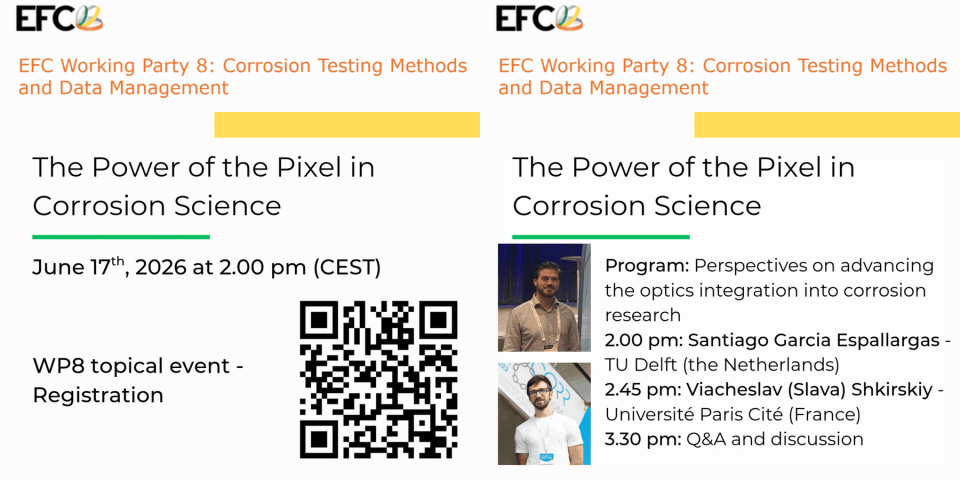
Coming up next:
WP8 topical event – "The Power of the Pixel in Corrosion Science" (EFC event 558). Santiago Garcia Espallargas (TU Delft, the Netherlands) and Viacheslav (Slava) Shkirskiy (Université Paris Cité, France) will discuss perspectives on advancing the optics integration into corrosion research.
It will take place on June 17th, 2026 at 2.00 pm (CEST)
Registration here
Active participation
WP8 welcomes active participation from its members. Everyone is invited to propose/co-organize activities, shape upcoming activities, and share and initiate opportunities for collaboration. Interested participants are invited to contact the Chair and/or Co-chair for further discussion and interaction.
Get involved!
If you wish get involved with EFC and the activities of the Working Party please click here to register!
Topics
WP8 is structured around four main pillars — methodology and metrology, correlative and applied testing, data curation and analysis, and intersectoral collaboration. These topics serve as guidelines for the Working Party’s focus areas, while remaining open to other subjects that may arise from emerging scientific and technological developments.
1. Methodology and Metrology
· Micro- to nano-electrochemical techniques (micro-capillary, SVET, SKPFM, LEIS, etc.)
· Advanced optical, spectroscopic and local electrochemical methods
· Hyphenated (in-situ, operando) techniques (e.g. AFM-FTIR, reflected light microscopy-electrochemistry, structural analysis-spectroscopy, TEM/STM, etc.)
· Use of advanced techniques such as those using x-ray, positrons and neutrons
· Metrology, traceability and uncertainty evaluation in corrosion testing
· Validation, benchmarking and harmonization of test procedures
· High throughput
· Field testing
· Lab testing simulation of real conditions
2. Correlative and Applied Testing
· Correlation of laboratory methods with accelerated and in-field behaviour
· High-throughput and automated screening approaches
· Testing in specialized environments (e.g. biomedical, energy, hydrogen), in collaboration with corresponding WPs for trans-sectorial cross-fertilization
· Corrosion sensor development and real-time monitoring
3. Data and Intersectoral Collaboration
· Application of FAIR data principles for interoperability and reuse
· Integration of experimental and modelling approaches (e.g. digital twins)
· Machine learning
4. Intersectoral collaboration
· Correlative and multi-modal data interpretation across sectors: Development and application of correlative and multi-modal approaches to interpret corrosion data, examining how identical techniques and datasets are analyzed, valued, and interpreted across academia, industry, and standards organizations
· Interlaboratory and intersectoral cooperation across academia, industry and standard bodies: These efforts aim to harmonize practices across laboratories and sectors, strengthening the connection between experimental research, industrial implementation, and standardization